Buying Guides
Best Turtle Pond Pump: What to Buy for Clean, Safe Water
Turtles are far messier than fish, so a turtle pond needs a tougher pump and a bigger filter. Here is how to size both, with five proven picks.
This guide contains affiliate links. As an Amazon Associate I earn from qualifying purchases. How this works.
✅ The short answer
The best turtle pond pump is a solids-handling pump with a protective cage, sized to move the whole pond at least once an hour, feeding a filter rated for two to three times your pond’s volume. For most backyard turtle ponds, the Aquascape AquaForce 1000 is the pick.
Turtles make much more waste than fish. A setup that keeps a goldfish pond clear will struggle with turtles, so size up.
Turtles are wonderful pond pets. They are also messy. They eat a lot, they shred their food, and they produce far more waste than fish of the same size. Put a normal fish-pond pump in a turtle pond and you will soon have green, smelly water and a clogged intake.
This guide shows you how to choose the best turtle pond pump. You will learn why turtles need a different kind of pump, how to size the pump and filter, how to keep your turtles safe around the equipment, and which models are worth a look.
Two honest notes. First, this is desk research based on published product details. We have not tested these pumps. Second, this guide is about pumps and filters, not turtle health. For care questions, ask a reptile vet or your local herpetological society.
Why a turtle pond needs a different pump
- More waste. Turtles produce a heavy load of solid waste. The pump has to carry that waste to the filter without choking on it.
- Messy eating. Bits of food and plant matter float around and get pulled into the intake.
- Shallow water. Turtle ponds often have shallow areas and sloping sides for basking. The pump must stay fully under water even when the level drops.
- Curious animals. Turtles climb on, dig under and bump into everything. The pump, hose and cables need to be secure.
- Safety. A turtle, especially a small one, must not be able to get stuck against a strong intake.
What that means for your pump
You want three things. Solids handling, so waste passes through to the filter. A cage or pre-filter, so turtles and large debris are kept away from the intake. And enough flow to turn the pond over often.
Key insight: In a turtle pond, the pump is only half the answer. The filter does the cleaning. The pump’s job is to deliver the mess to it, all day, without clogging.
How to size a turtle pond pump and filter
Step 1: Work out your pond volume
For a rectangular pond, multiply length × width × average depth × 7.48 (in feet) to get US gallons. Example: a turtle pond 8 ft by 5 ft with an average depth of 1.5 ft holds 8 × 5 × 1.5 × 7.48 = about 450 gallons. Our pond volume calculator will do it for you.
Step 2: Choose your flow
Plan to move the whole pond at least once an hour. Many turtle keepers aim for more, up to twice an hour. For our 450-gallon example that means 450 to 900 GPH reaching the filter.
Step 3: Oversize the filter
This is the big one. A common rule among turtle keepers is to choose a filter rated for two to three times the actual volume of the pond. So a 450-gallon turtle pond wants a filter sold for a pond of about 1,000 to 1,500 gallons. Filter ratings assume a fish pond, and turtles are a much heavier load.
Step 4: Check the flow against the filter
Every filter has a maximum flow. Make sure the pump’s flow at your lift is not higher than that. Our guide to matching a pump to a filter explains how.
| Turtle pond size | Pump flow to aim for | Filter rated for | Good pump match |
|---|---|---|---|
| Up to 250 gallons (stock tank) | 250–500 GPH | 500–750 gallons | Tetra Water Garden Pump 550 |
| 250–500 gallons | 500–1,000 GPH | 1,000–1,500 gallons | Aquascape AquaForce 1000 |
| 500–1,000 gallons | 1,000–2,000 GPH | 2,000–3,000 gallons | AquaForce 1000 or larger |
| 1,000–2,500 gallons | 2,000–3,500 GPH | 3,000 gallons or more | Tetra Debris-Handling Pump |
Rules of thumb used by many turtle keepers. Flow is what should reach the filter, after the pump has lifted the water.
💡 Good to know: The flow on the box is measured with no lift. Once the pump pushes water up to a filter or waterfall, you get less. See head height explained.
Keeping turtles safe around the pump
- Use a caged pump or a pre-filter. A wide cage spreads the suction over a big area, so no single spot pulls hard enough to trap a turtle.
- Never run a bare intake pipe. An open pipe end can hold a small turtle against it.
- Keep hatchlings out of big-pump ponds, or screen the intake with fine mesh that small turtles cannot get through.
- Secure the pump. Set it on a flat stone so it cannot be tipped, and route the hose where turtles will not dislodge it.
- Protect the cable. Keep it tidy and out of the basking area.
- Give them an easy way out. Sloping sides or ramps let a tired turtle leave the water. That matters more than any pump.
⚠️ Health note: Turtles can carry Salmonella germs even when they look healthy. Wash your hands with soap after touching turtles, pond water, or pond equipment, and never clean pump parts in a kitchen sink.
The best turtle pond pumps and filters
For each pick we explain why it works, who it is best for, and what problem it solves.
1. Aquascape AquaForce 1000: best turtle pond pump overall

Why it works: the cage spreads the suction and the solids-handling design keeps waste moving to the filter. The problem it solves: the constant clogging you get with a fine-mesh fish-pond pump in a turtle pond.
2. Tetra Pond Debris-Handling Pump: best for large turtle ponds
Why it works: it is designed to move debris, not strain it. The problem it solves: a large, heavily stocked turtle pond where smaller pumps block within days.
3. Aquascape UltraKlean 2000: best filter to pair with your pump

Why it works: waste is trapped and broken down in one sealed unit, and the UV deals with the green water that turtle ponds are prone to. The problem it solves: cloudy, smelly water that a pump alone can never fix.
4. Tetra Pond Water Garden Pump 550: best for small turtle tubs

Why it works: a 150-gallon tub turned over three times an hour stays far fresher. The problem it solves: an affordable start for a small turtle setup.
5. Aquascape Pond Air 2: best add-on for oxygen
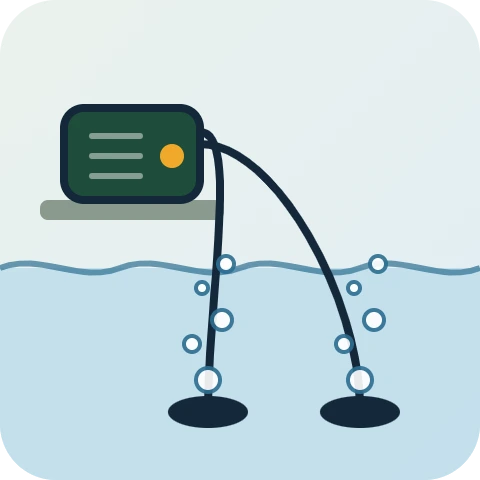
Why it works: the helpful bacteria in your filter and pond need oxygen to do their job. The problem it solves: sluggish, smelly water in summer. See our guide to pond aerators.
Side-by-side comparison
| Product | Type | Flow or rating | Power | Best for |
|---|---|---|---|---|
| AquaForce 1000 | Caged solids pump | 1,070 GPH | 55 W | Most turtle ponds |
| Tetra Debris-Handling | Solids pump | 3,150–3,690 GPH | 173–199 W | Large ponds, adult turtles |
| UltraKlean 2000 | Pressure filter + UV | Rated to 2,000 gal | 14 W UV | The filter to pair with a pump |
| Tetra 550 | Caged mag-drive pump | 550 GPH | 40–42 W | Stock tanks and tubs |
| Pond Air 2 | Air pump kit | 2 outlets | 6 W | Extra oxygen |
Figures are from Amazon.com listings and US retailers, checked in October 2026.
For the running cost of any pump at your own electricity rate, use our energy cost calculator.
Water quality basics for turtle ponds
A pump and filter are only tools. What you are really managing is the water. Three things tell you how well your setup is working.
- Smell. Healthy pond water smells earthy, not foul. A bad smell means waste is building up faster than the filter can deal with it.
- Clarity. Green water is algae feeding on nutrients from waste. Brown, cloudy water usually means stirred-up dirt or an overloaded filter.
- Test results. A simple pond test kit measures ammonia and nitrite. Both should read zero in a settled pond. If they do not, the filter is too small, too new, or needs more flow.
If any of these are off, work through this order: feed less, clean the pump intake, rinse the mechanical part of the filter in pond water, and change part of the water. Only then think about a bigger pump. Most of the time the answer is more filtration, not more flow.
How to set up a turtle pond pump
- Place the pump in the deepest spot, on a flat stone a few inches off the bottom, so it stays covered and does not sit in sludge.
- Fit the cage or pre-filter. Never run the pump without it in a turtle pond.
- Run the hose to the filter. Use the widest hose your pump accepts, and keep the run short.
- Return the clean water at the far end. Water should travel across the whole pond on its way back to the pump.
- Keep the pump away from the basking ramp. Turtles should be able to climb out without crossing cables or hoses.
- Plug into a GFCI outlet. Make a drip loop in the cord so water cannot run into the socket.
- Run it day and night. The bacteria in the filter need a constant flow.
⚠️ Safety first: Water and electricity are a dangerous mix. Always unplug the pump before you put your hands in the pond or touch the equipment. Never lift a pump by its cord. Plug into a GFCI-protected outdoor outlet, and if the GFCI keeps tripping, stop using the equipment and have it checked. For any fixed outdoor wiring, hire a licensed electrician.
7 common mistakes (and how to fix them)
- Using a fish-pond setup. Fix: size the filter for two to three times your pond volume.
- Choosing a fine-mesh pump. It will clog daily. Fix: pick a solids-handling pump.
- Running a bare intake. Fix: always use a cage or pre-filter so turtles cannot be held against it.
- Letting the water level drop. Shallow turtle ponds lose water fast in summer. Fix: top up often so the pump stays covered.
- Relying on the pump alone. Fix: a pump moves water. A filter cleans it. You need both.
- Cleaning the filter with tap water. Chlorine can harm the helpful bacteria. Fix: rinse filter media in a bucket of pond water.
- Overfeeding. Uneaten food is the main cause of dirty water. Fix: feed only what is eaten in a few minutes, as your vet or care guide advises.
Pro tips from turtle pond keepers
- Add a bottom drain or sloped floor if you are building new. Why it works: waste collects at one low point, right where the pump can take it.
- Rinse the pump cage weekly. Why it works: a clear intake keeps the flow up. Our cleaning guide shows the steps.
- Use plants in a separate bog area. Why it works: plants soak up nutrients, and a separate zone stops turtles eating them all.
- Do partial water changes. Why it works: even a great filter cannot remove everything. Swapping some water regularly keeps it fresh.
- Keep a spare pump. Why it works: a failed pump in midsummer turns a turtle pond bad quickly.
- Test your water. Why it works: a simple pond test kit warns you about ammonia before you can smell it.
Remember: if your turtle pond water is dirty, the fix is almost never a bigger pump. It is a bigger filter, less food, and a clean intake.
Real-life examples
These are typical situations we put together to show how the choice works. They are illustrations, not customer reviews.
Two sliders in a stock tank
The setup: a 150-gallon stock tank on a patio with two adult red-eared sliders. The choice: the Tetra 550 feeding a small filter rated for 500 gallons. The owner rinses the cage every few days.
The backyard turtle pond
The setup: a 450-gallon liner pond with four adult turtles and a sloped basking beach. The choice: the AquaForce 1000 with the UltraKlean 2000. The filter is rated for more than four times the pond volume, which suits the heavy turtle load.
The big mixed pond
The setup: a 2,000-gallon pond with turtles and a waterfall, under trees. The choice: the Tetra Debris-Handling Pump in a skimmer, with a large filter and an aerator for summer.
Frequently asked questions
Do turtles need a pond pump?
Yes. Without a pump and filter, waste builds up quickly in a turtle pond. Moving water through a filter keeps it healthier for the turtles.
What size pump do I need for a turtle pond?
One that moves the whole pond at least once an hour after lift losses. For a 500-gallon turtle pond, aim for 500 to 1,000 GPH reaching the filter.
Can I use a fish pond pump for turtles?
You can, but a fine-mesh fish-pond pump will clog much faster. A solids-handling pump with a cage is a better choice.
How big should a turtle pond filter be?
A common rule among turtle keepers is a filter rated for two to three times the real volume of the pond, because turtles produce so much more waste than fish.
Is a pump dangerous for turtles?
A properly guarded pump is not. Use a caged pump or a pre-filter, never a bare intake, and take extra care with hatchlings.
Should a turtle pond pump run all the time?
Yes. The filter bacteria depend on constant flow. See should a pond pump run all the time.
Your final buying checklist
- ✅ I know my pond volume in gallons
- ✅ My pump will move the pond at least once an hour
- ✅ The pump is solids handling, with a cage or pre-filter
- ✅ My filter is rated for 2–3 times my pond volume
- ✅ The pump’s flow does not exceed the filter’s maximum
- ✅ The pump will stay under water at my lowest water level
- ✅ Turtles cannot reach a bare intake
- ✅ I have a GFCI outlet within reach of the cord
- ✅ I will wash my hands after handling pond gear
Ready to choose?
For most backyard turtle ponds, the caged, solids-handling AquaForce 1000 is the place to start.
Buy the AquaForce 1000 from Amazon →
As an Amazon Associate I earn from qualifying purchases.
How we researched this guide
This article is desk research, not a hands-on test. In October 2026 we collected the specifications shown on the Amazon.com listings for each product and applied sizing rules of thumb widely used by turtle keepers. Where sources gave different numbers, we showed the range or flagged it. We do not quote prices, star ratings, or stock levels because they change daily. Manufacturers also update products, so please confirm the details on the current listing and in the manual before you buy.
Related guides
Best Large Pond Pumps: How to Move Big Water Without a Big Bill
Ponds over 5,000 gallons need a different plan. Learn how to size a large pond pump, choose the pipe, cut running costs, and compare five strong picks.
Little Giant Pond Pumps: A Simple Guide to Every Range
Little Giant makes three very different kinds of pond pump. This guide explains the F-Series, WGP and PE ranges in plain English, with specs and running costs.
Aquascape Pond Pumps Review: Which Model Fits Your Pond?
Ultra, AquaForce, AquaSurge or AquaSurge PRO? This plain-English review explains each Aquascape pond pump range, who it suits, and what it costs to run.