Waterfalls, Fountains & Solar
How to Choose a Waterfall Pump
Size a waterfall pump from the spillway width and the look you want, then check it against the lift and the pipe. A worked example shows how.
This guide contains affiliate links. As an Amazon Associate I earn from qualifying purchases. How this works.
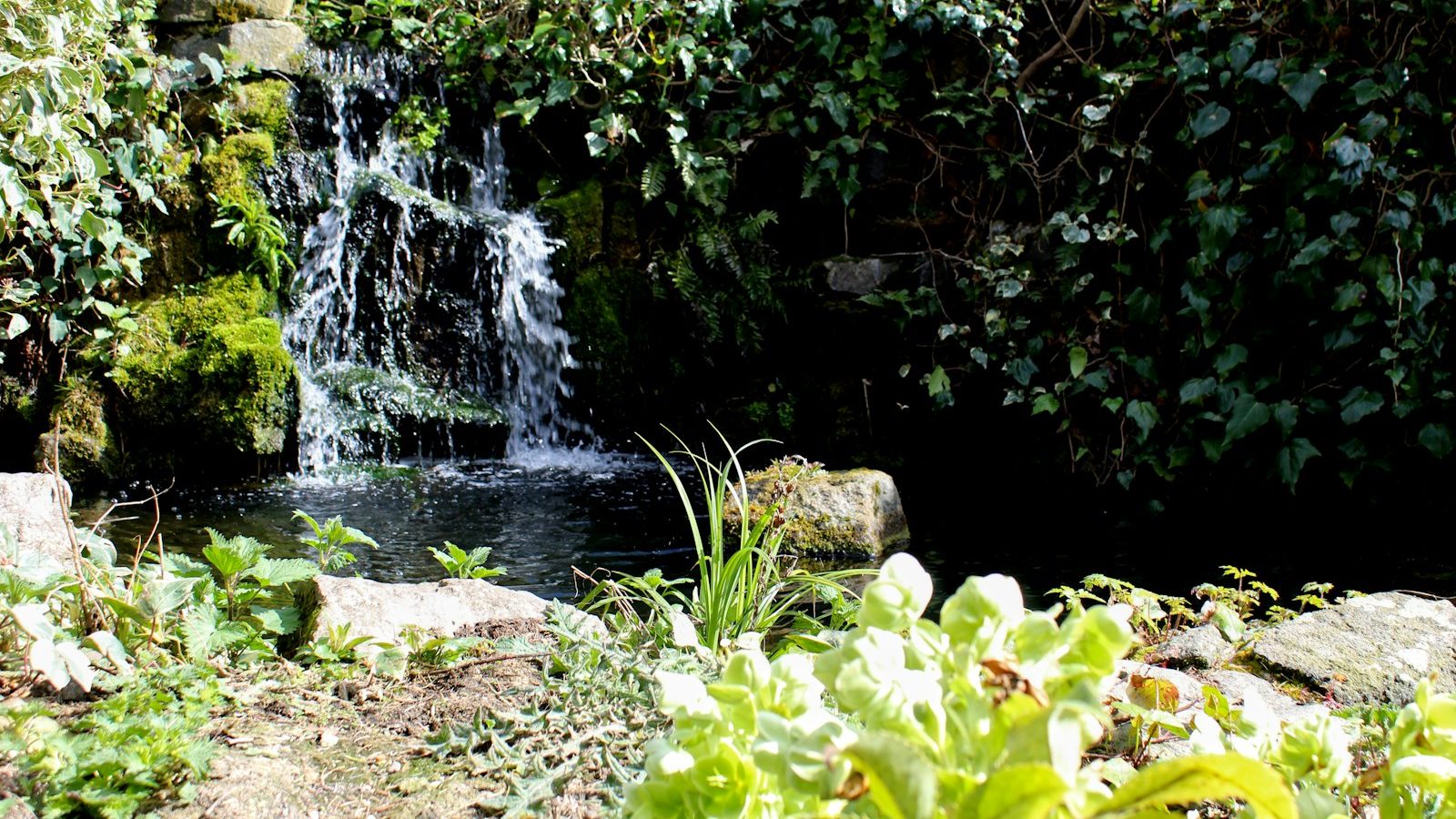
Allow about 100 US gallons per hour for every inch of spillway width for an even sheet of water. Then choose a pump that delivers that flow at the height of your waterfall plus the friction in the pipe. A 12-inch spillway needs roughly 1,200 GPH at the top.
A waterfall is sized differently from the rest of a pond. The pond’s volume barely matters; what matters is how wide the water spills and how high it has to be lifted. Get those two measurements and you can size the pump in a few minutes, or let the waterfall flow calculator do it.
Step 1: Decide how the waterfall should look
Measure the width of the spillway or weir lip in inches, then pick the effect you want.
| Look | Flow per inch of spillway width | 12 in spillway | 24 in spillway |
|---|---|---|---|
| Gentle trickle | about 50 GPH | 600 GPH | 1,200 GPH |
| Even sheet | about 100 GPH | 1,200 GPH | 2,400 GPH |
| Strong, noisy flow | about 150 GPH or more | 1,800 GPH | 3,600 GPH |
These are common rules of thumb used across the pond trade, and builders vary in the figures they prefer. Natural rock waterfalls split the water into channels, so they often look fuller than a smooth weir at the same flow. If in doubt, size for the higher figure and fit a valve so you can turn it down.
Step 2: Measure the lift
Measure vertically from the surface of the pond (or the water level in a pondless basin) to the point where the pipe discharges at the top of the waterfall. That is your static head. Do not measure along the slope.
Step 3: Account for the pipe
Waterfall flows are high, and high flows punish narrow pipe. For an 18-inch spillway at an even sheet you need about 1,800 GPH. Here is what 25 ft of smooth pipe with three elbows adds at that flow:
| Pipe inside diameter | Estimated friction head at 1,800 GPH | Verdict |
|---|---|---|
| 1 inch | about 20 ft | Unworkable: friction exceeds most waterfalls’ lift many times over |
| 1 1/2 inch | about 3 ft | Acceptable |
| 2 inch | under 1 ft | Best: the pump works almost entirely on lift |
Calculated with the Hazen-Williams equation (C = 140), allowing 30 pipe diameters per elbow. Estimates, not measurements.
The lesson is consistent: choose the pipe first, and choose it generously. Our head height guide explains why friction rises so steeply.
Step 4: Read the pump curve at the total head
Add the lift to the friction to get the total head. Then look for a pump whose curve shows your target flow at that head.
Worked example
- Spillway: 18 inches wide, even sheet. Target flow: about 1,800 GPH.
- Lift: 4 ft from the pond surface to the top of the waterfall.
- Pipe: 25 ft of 1 1/2 inch hose with three elbows adds about 3 ft.
- Total head: about 7 ft.
- Pump: one whose curve shows roughly 1,800 GPH at 7 ft of head. Its maximum flow figure will be considerably higher than 1,800 GPH, and its maximum head should be well above 7 ft.
Step 5: Check the rest of the system
- The filter. If the waterfall is fed through a filter, the flow must stay within the filter’s maximum. If the waterfall needs more, use a bypass or a second pump, as described in matching a pump to a filter.
- The pond’s turnover. A large waterfall on a small pond can turn the water over far more often than needed. That is usually harmless for the water but can create strong currents.
- Water in transit. When the pump starts, water leaves the pond to fill the stream and waterfall, and the level drops. In a pondless waterfall, the basin must hold enough to supply this without exposing the pump.
- Splash and evaporation. Higher, stronger falls lose more water. Check the pond level regularly and investigate if you are topping up often.
Features to look for in a waterfall pump
- A curve that holds flow at height, with a maximum head comfortably above your total head.
- A wide outlet, typically 1 1/2 or 2 inches on pumps in this class.
- Solids handling, since waterfall pumps often sit in a skimmer or vault where debris collects.
- A way to adjust the flow, either a valve on the outlet or a variable-speed control.
- Reasonable wattage for the flow delivered. See running costs.
Frequently asked questions
How many GPH do I need for a 2-foot-wide waterfall?
About 2,400 GPH at the top of the waterfall for an even sheet, around 1,200 GPH for a gentle trickle, and 3,600 GPH or more for a strong flow.
Can I run a waterfall from my filter pump?
Yes, and many ponds do, provided the flow suits both the filter and the waterfall. If they need very different flows, split the flow with a bypass or use separate pumps.
Why does my waterfall look weak with a big pump?
Almost always because of head: the lift, a hose that is too narrow, or a clogged intake. Work through weak waterfall flow in our troubleshooting guide.
Related guides

Solar Pond Pumps: Benefits, Limitations and Who They Suit
Solar pumps cost nothing to run and need no outdoor socket, but their output follows the sun. Here is where they work well and where they fall short.

What Size Pond Pump Do I Need? A Step-by-Step Guide
Work out your pond volume, pick a sensible turnover rate, add up the head height, then read a pump curve. Here is the full method with a worked example.

Pond Pump Head Height Explained: Why Lift Cuts Your Flow
Head height is the reason a pump rarely delivers the flow printed on its box. Learn what counts as head, how to estimate it, and how to read a pump curve.